

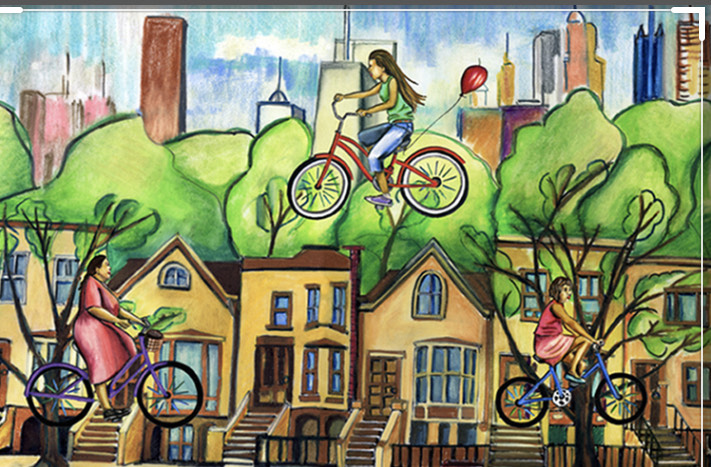
By Abesi Manyando: Perhaps she thought that I was not as interested in engaging in a conversation with her as she attempted to dialogue with me. It would have been easier to put up a front and ask predictable questions just to solidify a quick interview but her authenticity and niceness could never have allowed me to do that. Author, Sandra Cisneros is much too special and too important in my life for me to have treated her as a mere subject of my writing artistry. I had memorized her stories, poetic paragraphs and manuscripts years ago. Her novel, The House on Mango Street was an assignment in literature class that became my template for exceptional free writing.
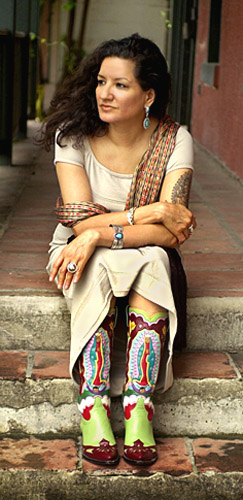
The powerful vignettes continue to open up windows of uninhibited creativity that leave room for unoccupied spaces of simplicity helping readers {such as myself} identify, relate and understand the poignant coming of age story about Esperanza and her neighbors.
Mango Street is the avenue that displays that the art of realism mixed with working class dreams and hopes can engage everlasting conversations in classrooms across America. The novel that allowed students to take a glimpse inside one aspect of Latina life when America was still a bit more separated is now part of the educational curriculum in schools across the country. This heartfelt book also showed how we are all much more alike then we are different.
While our names may sound different and our languages may not always be familiar, we dream in identical colors, feel with similar reservations, and love in different magnitudes but with the hopes of the same promising endings that are perpendicular to the goals of most human beings.
Cisneros’ book is a mirror reflection of different parts of many of our lives or that of those we know- collected through rhythmic poetry-like essays and open thoughts that are binded in paperback. The stories about Esperanza, her sisters, the Vargas kids, Sally, Elinita and Mamacita could easily be pulled out of any working class neighborhood in Bed-Stuy, Chicago Heights, the Bronx, Saint Louis, Oakland, Calcutta, Johannesburg or Kingston. The vignettes are that universally captivating and appealing. Everyone and anyone who is unashamed and comfortable enough with their own upbringings {what ever they may be} can relate and embrace the story of the girl whose name means hope. 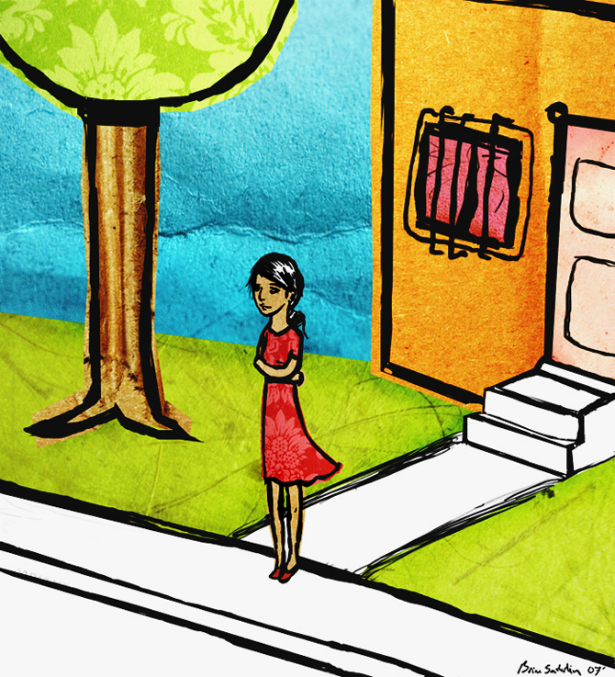 Esperanza, the one who says diseases have no eyes…the one who understands the four skinny trees, four who grew despite concrete. Esperanza’s journey is delicately written with the absence of a time-line. I had to read and re-read the novel because the invisible dates made me wonder how old Sally was and what made Esperanza so shy and whether Minerva ever became happy. I wanted to know if Darius from Darius & the Clouds was brown with a low haircut because through Cisneros’ words he reminded me of Tyrone from first grade. Like Tyrone, “Darius who chased girls with fire crackers or a stick that touched a rat and thinks his tough” took a moment to point out that the biggest cloud in the sky, “that one there next to the one that looks like popcorn that’s God,” he had said. Even with all his naughtiness, that’s something Tyrone would have said in class— when he wasn’t suspended. I would have told Sandra Cisneros that and had planned to. I would have said that I, along with my friends had fallen in love with her free-writing style because it wasn’t as technical as college credit advanced composition. I would have explained that our teacher, Mrs. Tipton didn’t care that we were only high school juniors doing a sophomore college course because she thought that mastering Advanced Comp. was as important or as close to getting accepted not into college but rather heaven. The technicalities of Advanced Comp. were like a restricted life and death matter but I felt that the technical emphasis took away from the creativity to be free. Free, like Esperanza’s simple stories about hair, hips and those who don’t know about her neighborhood and are scared. Free and uninhibited like her creator— the woman who was celebrating the twenty-fifth anniversary of her historical social changing book. Miss Cisneros was not contrived but rather very open and real. She didn’t have rehearsed lines to recite or tell. She didn’t read from a script. She just conversed about her amazing journey while writing The House on Mango Street. She pieced together all the puzzles that were loose in our minds, puzzles that we didn’t really have to know in order to follow the story but puzzles that made as inquisitive nevertheless. She apologized for not having been as available for her readers and fans saying that her mother had just recently passed away and her father had also passed before that.
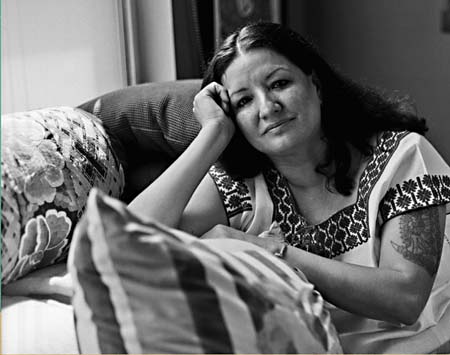
“She needed time away,” she said. As she answered a question about Darius & the Clouds saying it was her favorite story, she suddenly said “I wish there was someone who could give a warning and insight on CNN or something saying that losing your parents will totally change your life. “She looked up sighing and somewhat perplexed and said, “there is just no preparation for becoming an orphan.” At that moment she shifted my intentions. Sandra Cisneros…here she was in her early fifties with sadness in her eyes and a sense of loss that was too profound to hide – standing there and somewhat questioning the physical disappearance of her mother and father. One of my favorite writers who I had been waiting to meet was right in front of my eyes. She was disarming and un-protective of her dash of melancholy…unapologetic for having feelings that were as transparent as a glass vase. She allowed those of us who were in her presence to see every element of her emotions and suddenly she became that much more real, powerful and connecting to me. I remember she had once written that, “emotions cannot be invented or borrowed” and I was able to confirm her own thoughts through herself. She was looking at me and asking me to tell her what my name meant with a cloud of sadness in her eyes or maybe distant fatigue- that maybe only I could see. The sadness in her eyes affected my entire disposition towards her and perhaps I was too overwhelmed in her emotions to think about myself and an interview. I think that her human-ness and the reality that even with all her wisdom she was not above all those things that each of us feel and wonder took me by surprise. Her vulnerability was completely unmasked. The woman who once wrote that she was able to get to where she wanted to be by not being afraid of the things that made her afraid was much more open than I expected her to be. In an early 2003 interview with the Seattle Times by Jen Buckendorff, Cisneros had attributed her new insights of life to the loss of her father stating that, “The book {Caramelo} saved me from the sadness. Because you can be extremely heartbroken and write about something heartbreaking, but if you stay with it long enough, it will bless you with light.” So instead of asking her questions and sharing my thoughts about each vignette, I just gave her a big hug because I believe it was the most essential thing that I could have done at that moment. It was not the time for an interview and meeting the simple requests of an unforgiving editor. It was a moment to feel and listen This was a reflective moment that she brought out in me and continues to bring out in all her readers through classic books like, “The House on Mango Street, Caramelo and her recent addition ”A House of my own” It was a moment for me to be free of expected obligations and just simply remember my spirit.
Cisneros’ newest book “A House of my own” is now available in hardback and online. Please visit Sandra Cisnoros’ site for more information. Thank you for reading- Ab.